

[Kengo Kuma Exhibition: Introducing new projects after changing exhibits!]
We would like to introduce some new projects that have been added to the Karuizawa exhibition.
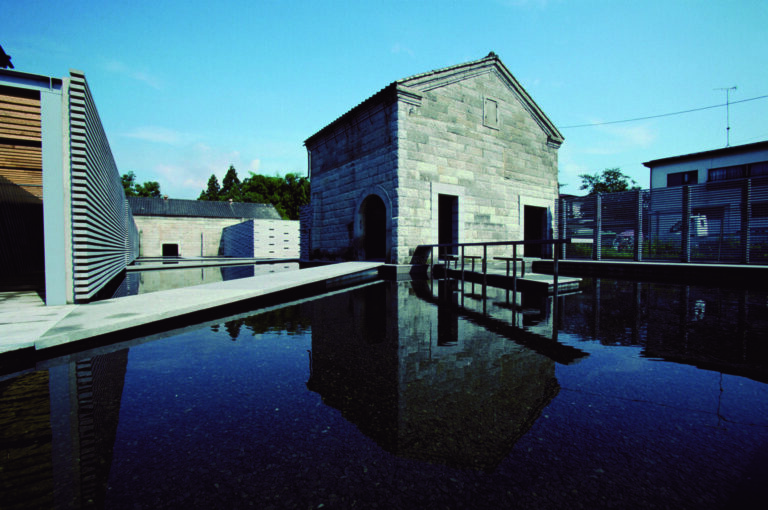
Nasu Ashino Stone Museum STONE PLAZA (2000, Tochigi).
Nasu Town in Tochigi Prefecture is known as a resort town, but Ashino is outside of that area.
It was a rustic post town that appears in Matsuo Basho's Oku no Hosomichi.
This project was started by Nobuo Shirai, president of a stoneworks company, who came across an old stone storehouse that was over 80 years old, and used the stones to create the storehouse.
It all started with a request to create a museum that would showcase stone art and crafts, and serve as an architectural example.
The local "Ashino stone" can be quarried in-house for free, and stonemasons can be employed freely, but there is no other budget.
It took five years to complete.
This building posed two technical challenges. The first was that it was built using masonry, a method of stacking stones while leaving gaps between them.
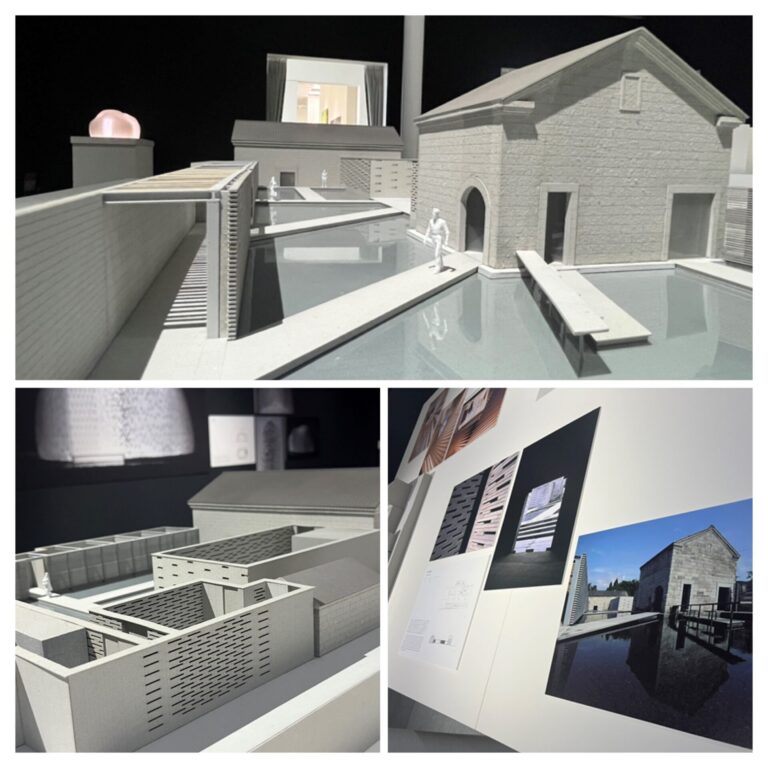
The second was to create a light and bright stone wall using stone louvers (thin, long, slat-like material arranged in a row).
They consulted with engineers to design the structure, and conducted repeated experiments, relying on the experience of stonemasons, to determine how thin the stone could be cut without cracking. The result was the "stone lattice" made by stacking Ashino stone cut to a thickness of 50 mm.
The light-transmitting marble embedded in some of the stone walls allows wind and light to pass directly between the stones, and each building is connected by a stone bridge. The surrounding water basins reflect the sky, and the space has a delicate appearance that changes depending on the season and the weather of the day, creating a beautiful space that harmonizes with the landscape.
The Stone Museum has won numerous awards, including the International Stone Architecture Award (Italy), and has become one of the pioneering examples of Kuma's signature "materialist architecture."